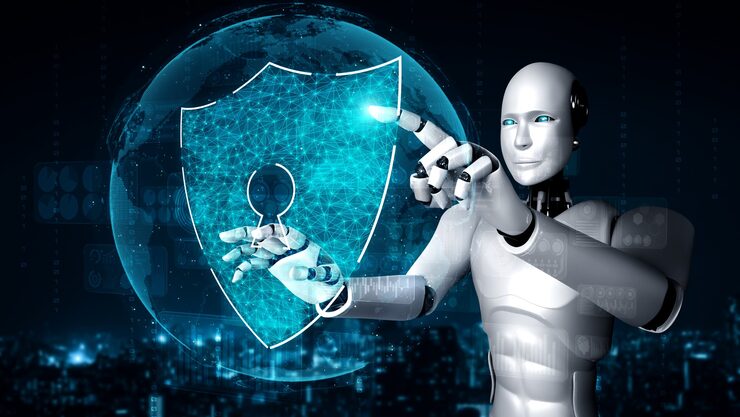
In today’s hyper-connected world, cybersecurity is no longer optional — it’s essential. With the rise of digital platforms, online payments, and smart devices, cyber threats are becoming more advanced than ever before.
Enter Artificial Intelligence (AI) — the game-changing technology that’s redefining how we protect data and defend systems. AI is transforming cybersecurity from a reactive approach to a proactive shield, capable of identifying and stopping threats before they strike.
Let’s explore how AI and cybersecurity are working together to secure the digital future.
1. The Growing Need for Smarter Cybersecurity
Cyberattacks are becoming more sophisticated and frequent. Traditional security systems often struggle to detect new forms of malware or phishing tactics.
That’s where AI comes in — it learns from patterns, analyzes massive datasets, and detects suspicious behavior that human analysts might miss.
Fact: According to a recent report, AI-based cybersecurity tools can reduce threat detection time by up to 80% compared to manual monitoring.
AI and cybersecurity
2. AI for Threat Detection and Prevention
AI systems can scan vast amounts of data in real time — from login activity to network traffic — and identify anomalies that suggest an attack.
Machine learning (ML) models continuously adapt and learn from new threats, improving their accuracy over time. This makes AI ideal for detecting zero-day attacks that traditional software might not recognize.
Example: Banks and financial institutions use AI to monitor transactions and instantly flag suspicious activities, preventing fraud before it happens.
3. Predictive Cybersecurity: Stopping Attacks Before They Happen
AI doesn’t just react — it predicts. Using predictive analytics, AI can forecast potential vulnerabilities and identify weak points in systems.
This helps cybersecurity teams stay one step ahead of hackers by reinforcing those areas before any damage occurs.
Think of it as having a “digital security guard” that anticipates danger before it arrives.
4. Fighting Phishing and Social Engineering
Phishing remains one of the most common cybercrimes. AI tools can analyze email content, sender behavior, and link structures to detect fraudulent messages automatically.
Advanced AI-powered spam filters can now block over 99% of phishing attempts, protecting users from identity theft and data breaches.
5. Automating Security Responses
When a threat is detected, every second counts. AI-driven systems can automatically respond to cyber incidents — isolating affected systems, blocking malicious IPs, and alerting security teams instantly.
This rapid response helps minimize damage and reduce downtime for businesses.
Example: Cloud service providers use AI automation to detect unusual activity and shut down compromised accounts in seconds.
6. Enhancing Data Protection and Privacy
AI enhances data encryption, access control, and user authentication. Techniques like behavioral biometrics use AI to analyze how a person types or moves the mouse, adding an extra layer of identity verification.
AI also helps detect data leaks by scanning for unauthorized data transfers and enforcing privacy policies across digital platforms.
AI and cybersecurity
7. Challenges of AI in Cybersecurity
While AI strengthens digital defense, it also comes with challenges. Hackers are now using AI-powered attacks, creating malware that can adapt and evolve.
There’s also the issue of false positives, where AI systems might flag safe activities as threats — which can slow down operations.
To overcome these issues, cybersecurity experts must combine human intelligence with AI automation, ensuring accuracy and ethical data use.
8. The Future of AI and Cybersecurity
The future of cybersecurity will depend heavily on AI-driven defense systems. As quantum computing, IoT, and 5G expand, AI will play a critical role in securing these complex environments.
In the next decade, we’ll see more autonomous security systems, capable of defending networks without constant human oversight.
The goal is clear: build a world where technology not only connects us — but protects us.
Conclusion
AI and cybersecurity are becoming inseparable. Artificial intelligence is redefining how we detect, prevent, and respond to digital threats — making the internet safer for individuals and organizations alike.
As cyber threats evolve, one thing is certain: AI is our strongest ally in protecting the digital future.
FAQs
Q1. How is AI used in cybersecurity? A: AI is used to detect threats, analyze suspicious behavior, automate responses, and predict potential attacks.
Q2. Can AI stop hackers? A: AI helps prevent many attacks by identifying unusual patterns, but human supervision is still vital for complex threats.
Q3. What is the future of AI in cybersecurity? A: The future includes fully automated defense systems, predictive security analytics, and AI-enhanced data protection.